How to Protect Your Edges When Getting Your Hair Done
Edges are the first place tension shows up and the last place people check. Here is how to look after your hairline before, during and after a style.
Most people notice their edges only when something has already changed. The hairline looks a little thinner than last year, or there is a small bald patch near the temple that was not there before. By then the damage has usually been building for a while, one tight style at a time.
Edges are fine and delicate compared with the rest of the hair, which is why they are the first place tension shows up. The encouraging part is that a lot of this is preventable, and most of the prevention happens before and during the appointment, not after.
This is general beauty advice, not medical advice. If you have patchy hair loss, pain or a scalp that looks inflamed, please see a doctor or a trained specialist.
H2: Why edges are so easy to damage
The hairs along your hairline are thinner and shorter than the hair at the crown, and they get pulled in more directions by almost every style. Braids, cornrows, ponytails, buns and wig installs all tend to anchor at the hairline, so that is where the strain concentrates.
Repeated tension over months is what does the harm. One slightly tight install is rarely a disaster. A pattern of tight styles, worn a little too long, with no break in between, is how edges thin out.
H2: Know the warning signs while the style is still in
Some tightness in the first day or two is normal. These signs are not.
- Small bumps or a raised, tender feel along the hairline
- Pain that gets worse instead of settling after a day or two
- Skin that looks stretched, shiny or pulled at the temples
- Redness or soreness around the roots
- A headache that keeps coming back while the style is in
If you notice any of these, the style is too tight. Do not wait to see if it improves. Ask your stylist to loosen it, or take it down if needed. Waiting to protect your money is how people end up losing hair.
H2: Say something in the chair
This is the part many people find hardest. You are sitting there, the stylist is working, and it hurts a little, but you do not want to seem difficult.
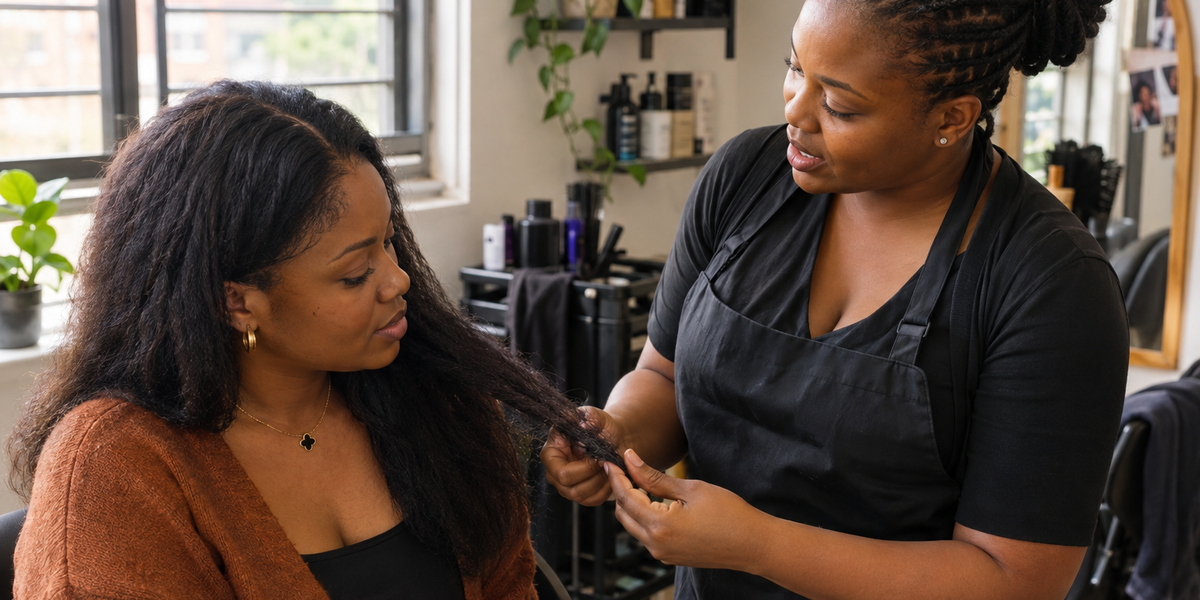
Speak up early. A good stylist would much rather adjust a section than have you leave in pain. Something like "this feels tight at the front, can you go a bit softer here" is a normal thing to say, and it is much easier to fix while the section is still being done. We cover the wider set of habits in mistakes to avoid when getting your hair styled, including why ignoring pain is one of the most common ones.
H2: Ask about tension before you book
You can learn a lot about how a stylist handles edges before you ever sit down. Ask how she keeps tension light at the hairline, and whether she adjusts for people with thinner edges. Pay attention to the answer. Someone who has thought about it will usually explain her approach easily. If she brushes the question off, that tells you something. Our guide on how to choose a hairstylist in Lagos has more on what to ask and what to watch for.
H2: Choose styles that are kinder to the hairline
Some styles put more strain on the edges than others, and how they are installed matters as much as which one you pick.
- Larger or medium sized braids usually pull less than very small, tight ones
- Styles that leave the hairline slightly looser, with the tension distributed further back, tend to be gentler
- Wigs and closures should sit on a neatly prepared base, and the front should not be pulled tight to keep the wig secure
- Slicked-back buns and ponytails worn daily, with gel and a lot of pulling, are a common cause of edge damage even without any braids
Our guide to protective hairstyles that actually protect your hair explains what a genuinely low tension style looks like.
H2: Look after your edges between styles
Edge care does not stop when the style comes down.
- Clean and moisturise the hairline gently, since dry, neglected edges break more easily
- Avoid brushing or slicking the same small area hard every day
- Go easy on strong edge gels and stiff products, and wash them out properly rather than letting them build up
- Give your hairline a rest between installs, even a few days, so it is not under tension constantly
- Take styles down at a sensible time, not weeks past when they should have come out
Careful takedown matters too, because rushing the front of the hair is a common way to lose strands. We cover it in how to take down braids without damaging your hair.
H2: Tell your stylist about past damage
If your edges are already thin, or a previous style left a sore patch, say so before the appointment. It changes how the sectioning is done and how much tension is used near the front. Hiding it does not help you, and the best results come from clear information. Arriving with clean, detangled hair also helps, because the stylist can be more careful when she is not fighting knots, as we explain in preparing your hair before a styling appointment.
H2: When professional help makes sense
Plenty of people look after their own edges well, and that is fine. But if you have had repeated problems with tension, or you want someone who will pay attention to the hairline rather than rushing through it, having an experienced stylist install the style can make a real difference. Zerrar Hairstyling makes it easier to book a hairstyling service, and you can raise your concerns about your edges before the appointment.
H2: The bottom line
Edge damage is usually slow, quiet and preventable. Notice the warning signs, speak up when something feels too tight, choose styles and stylists with the hairline in mind, and give your edges rest between installs. Your hairline will thank you over the long run.
Want your next style installed with your hairline in mind?
Book your hairstyling service through Zerrar Hairstyling:
https://hairstyling.zerrar.com
[email protected]
INTERNAL LINK OPPORTUNITIES: